Accepted Workshops & Tutorials
📌 Important Notice
- [W23] I Workshop on AIED Unplugged has changed to Half-day event from Full-day event.
- For workshops held at COEX and Elice, anyone who registered for full-conference or workshop-only pass can access the workshop venues without further registration.
- For workshops held at Multicampus, a QR code is needed for entry. For those who submitted their interest in the interest survey will received the QR code the day before the event. For those you didn’t submitted their interest, please send an email to Eunyoung Ko (eunyoung4444@gmail.com) with your name, email address used for registration and workshop that you’d like to attend.
Saturday Workshops (June 27th)
📌 All Saturday workshops are half-day sessions and will take place in the afternoon (1pm – 6pm).
Sunday Workshops (June 28th)
📌 Two half-day Workshops (1:00-6:00pm) and 12 full-day workshops (9am-6pm)
Workshops & Tutorial Venue
Workshops and tutorials will be held across three venues. Please check the venue for your session carefully, as Elice and Multicampus are sponsor venues that require a QR code for entry.
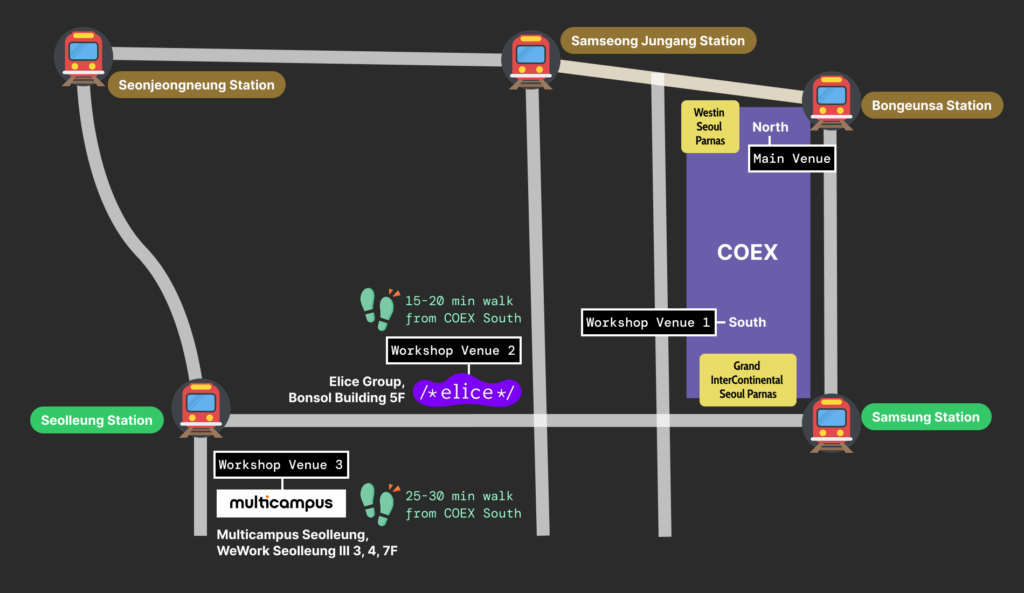
COEX
- Address: 513, Yeongdong-daero, Gangnam-gu, Seoul, South Korea
- Google Maps, Naver Map
Elice
- Address: 144-27 Samseong-dong, Gangnam District, Seoul (Bonsol Building, 5th Floor)
- Google Maps, Naver Map
- Distance from COEX: Approximately 15–20 minutes on foot
- Entry requires a QR code, which will be sent to the email address used for conference registration.
Multicampus
- Address: 889-41 Daechi-dong, Gangnam District, Seoul (3, 4, 7th floor)
- Google Maps, Naver Map
- Distance from COEX: Approximately one subway stop or 2–3 bus stops away; about 30 minutes on foot; nearest station is Seolleung Station Exit 2, Line 2 or Suin-Bundang Line.
- Entry requires a QR code, which will be sent to the email address used for conference registration.
- IMPORTANT: Multicampus has multiple locations. Please make sure to refer to the address above.
Workshops & Tutorial Coffee Break
Coffee and light refreshments will be provided at all workshop and tutorial venues during the following break times:
- Saturday: 3:15–3:45 PM
- Sunday: 10:15–10:45 AM and 3:15–3:45 PM
Please note that lunch will not be provided on both days. Participants may take a lunch break according to their workshop schedule.
Workshop & Tutorial Descriptions
8th International Workshop on Culturally-Aware Tutoring Systems (CATS2026)
Website: https://sites.google.com/view/cats2026aied/
📅 Saturday, June 27 (Half Day)
Type: Workshop
Description: With the growing adoption of educational technologies, culture has become an increasingly important consideration for the AIED community. This year’s AIED conference calls for AI to co-evolve with learners, enabling richer human-AI interaction and synergy. As prior work has mainly focused on general technology adoption for education, greater attention is needed to understand how learners can draw on their lived experiences, contexts, culture, and realities in their interactions with AI-mediated technologies. Therefore, the 2026 edition of the CATS workshop aims to engage interested researchers in a conversation on how to take culture and context into account in the design and operations of learner-AI interactions.
Organizers: Ivon Arroyo, Emmanuel G. Blanchard, Christine Kwon, Maria Mercedes. T. Rodrigo
AI4CAREER: Responsible AI for STEM Career Development at Scale in K-16 Education
Website: https://ai4educationk-16.com/
📅 Saturday, June 27 (Half Day)
Type: Workshop
Description: AI4CAREER invites researchers, educators, designers, and policymakers to explore how AI is shaping STEM career development across K–16 education. As AI becomes embedded in advising and career exploration systems, the workshop examines how to design and govern these technologies responsibly—ensuring they support learner agency and do not reinforce inequities. Participants will engage in lightning talks and interactive discussions to identify key challenges, design principles, and research priorities. We welcome short papers or motivation statements from those interested in advancing equitable, developmentally grounded AI for career pathways at scale.
Organizers: Sugana Chawla, Si Chen, Julia Qian, Gina Svarovsky, Ying (Alison) Cheng, Rick Johnson, Nitesh V. Chawla, Ronald Metoyer
Build and Deploy Microservices for Automated Feedback
Website: https://lambda-feedback.github.io/user-documentation/events/20260627_fol_kor_26/
📅 Saturday, June 27 (Half Day)
Type: Tutorial
Description: E-learning platforms are growing increasingly complex, embedding automated assessment and feedback tools to support learning at scale. One approach to addressing the ‘platform lock-in’ challenge of such tools is to source discipline-specific education microservices – modular, independent software that can be developed by domain experts and be reused across the entire sector, regardless of the platform employed. This half-day tutorial will introduce participants to education microservices for automated feedback using an active e-learning platform. Working in mixed-ability groups, participants will design, implement, and deploy a live microservice to evaluate student submissions on a specific learning task. By the end of the tutorial, participants will have contributed a working, publicly accessible automated feedback tool to an open-source education microservice ecosystem and engaged in community discussion on shared education microservice architecture and infrastructure.
Organizers: Alexandra Neagu, Peter B. Johnson, Marcus Messer, Fun Siong Lim
Ethical Artificial Intelligence and Education: The need for international regulation to foster human rights, democracy and equity
Website: https://aied2026.learning-innovations.eu/
📅 Saturday, June 27 (Half Day)
Type: Workshop
Description: The 4th Workshop “Ethical AI and Education (AI&ED)” is the continuation of the very successful workshops held at the AIED 2023 in Tokyo, Japan, AIED 2024 in Recife, Brazil, and AIED 2025 in Palermo, Italy. There is a huge need for international regulation of AI and Education to foster human rights, democracy and equity. We offer updates and want to raise and increase awareness on the important topic of ethical AI&ED. The Council of Europe (CoE) established an Expert Group on “Artificial Intelligence and Education” (AI&ED) in the year 2021 and is currently developing international laws and conventions for education with AI (AIED) and education about AI (AI Literacy). The interactive will discuss with you and all interested stakeholders what needs to be done related to ethical AI and education. A special focus will be on formal education for all, including AI use and policies for assessment to foster and improve human rights, democracy, and equity.
Organizers: Christian M. Stracke (University of Bonn, Germany), Beth Havinga (European EdTech Alliance, Germany), Wayne Holmes (University College London, UK), Ron Salaj (University of Turin, Italy), Daniel Burgos (Universidad Internacional de la Rioja, Spain), Jon Mason (Charles Darwin University, Australia)
Fair4AIED 2026: Second International Workshop on Fairness in AI-assisted Decision-Making for Education
Website: https://fair4aied.github.io/2026/
📅 Saturday, June 27 (Half Day)
Type: Workshop
Description: Education is being reshaped by AI: intelligent tutoring, risk detection, personalization, and unstructured learning with large language models are now commonplace. Ensuring fairness in educational AI remains difficult. Researchers already pursue auditing, mitigation, fairness-aware modeling, bias detection in datasets, and fairness metrics for learning settings—yet this work is often fragmented across subcommunities and only loosely connected to broader fairness ideas from the machine learning community. This workshop aims to bridge those gaps through interdisciplinary dialogue and exchange among researchers, practitioners, and policymakers. Through presentations and a panel, we share practical experience, surface open questions, and connect fairness ideas to actionable strategies for real educational systems—especially as generative AI evolves—advancing socio-technical approaches that go beyond purely technical fixes.
Organizers: Frank Stinar, Chengyuan Yao, Mirko Marras, Renzhe Yu, Nigel Bosch
From Tools to Teammates? Examining Human–AI Synergy in Educational Design Fictions through the Lens of Extended Cognition
Website: https://sites.google.com/view/from-tools-to-teammates/home
📅 Saturday, June 27 (Half Day)
Type: Workshop
Description: AI in education is no longer just a tool – it is increasingly becoming a “teammate” that shapes how learners think, reason, and construct knowledge. This raises fundamental questions about how cognitive work and responsibility are distributed between humans and AI. This participatory workshop explores these questions through the lens of extended cognition, using design fiction scenarios to examine future human–AI interactions in educational contexts. Participants will uncover underlying assumptions and value tensions and collaboratively develop theory-informed guidelines for designing and evaluating meaningful human–AI synergy in AIED, forming the basis for a potential joint publication.
Organizers: Florence Lehnert, Maka Eradze, Marcus Specht
GenAI as Semantic Sensors for Collaborative Learning
Website: https://crossmmla.org/
📅 Saturday, June 27 (Half Day)
Type: Workshop
Description: This half-day workshop invites the Multimodal Learning Analytics community to explore how GenAI and Large Language Models can serve as semantic sensors, moving beyond behaviour tracking to decode meaning, motivation, and coherence in collaborative learning. Through flash presentations, plenary discussions, and group discussions, participants share emerging tools and findings while addressing challenges such as bias, privacy, and cognitive overreliance. Outputs include open workshop proceedings, proposals for a special journal issue, and community building.
Organizers: Daniel Spikol, Andy Nguyen, Olga Viberg, Namrata Srivastava Roberto Martinez-Maldonado, Qi Zhou, Kester Wong, Richard Lee Davis, Sa’ar Karp Gershon, Marcelo Worsley, Xavier Ochoa
HAI-Agency: Workshop on Orchestrating Human and AI Agency for Proactive and Reflective Learning
Website: https://open-aied.github.io/HAI-Agency/
📅 Saturday, June 27 (Half Day)
Type: Workshop
Description: As research momentum shifts toward Agentic AI, educational technologies are moving beyond reactive tools toward proactive, teammate-like ecosystems grounded in pedagogical principles. This transition raises a central challenge: how to design increasingly autonomous AI systems without diminishing learner agency or undermining teachers’ professional judgment. This workshop introduces the concept of HAI-Agency, envisioning how human and AI agency can be orchestrated in learning and teaching. Foregrounding proactive and reflective learning, we aim to advance a shared research agenda spanning design methodologies, computational modeling, evaluation frameworks, and the classroom integration of agentic AI systems.
Organizers: Yiling Dai, Boxuan Ma, Huiyong Li, Patrick Ocheja, Kyoungwon Seo, Brendan Flanagan
Multimodal Affect in AI for Education (MAAI4Ed)
Website: https://multimodal-affect-ai4ed.github.io/
📅 Saturday, June 27 (Half Day)
Type: Workshop
Description: The Multimodal Affect in AI for Education (MAAI4Ed) workshop explores the critical intersection of artificial intelligence, emotional intelligence, and learning sciences. It focuses on leveraging multimodal data to detect and interpret learner affective states in real-time. Moving beyond simple detection, the workshop emphasizes the design of affect-aware AI systems that actively scaffold emotional regulation and promote learner well-being. By bringing together researchers and practitioners, the session aims to advance ethically responsible and inclusive AI interventions that treat emotion as a central component of the educational experience.
Organizers: Xiaoshan Huang, Andy Nguyen, Jie Gao, Haolun Wu, Yimeng Wang, Tony Ahn, Tiantian Jin, Roger Azevedo, Susanne Lajoie.
Open Adaptive Tutor 2.0: Chatbot Integration, Community Deployments, and Future Directions
Website: https://sites.google.com/berkeley.edu/fol26-oatutor-workshop
📅 Saturday, June 27 (Half Day)
Type: Tutorial
Description: The workshop will debut a chatbot integration framework for exploring educational system prompt design, along with the latest features of the Open Adaptive Tutor (OATutor) 2.0 platform. It will also feature guest speakers who will share their independent use of OATutor for research and instructional purposes, followed by hands-on activities in which participants design, test, and interact with GenAI-supported chatbot prompts. Through these activities, the workshop aims to lower the barrier to rapid research and development with adaptive tutors.
Organizers: Yerin Kwak, Allison Wang, Zachary A. Pardos
Open Learner Models in the Age of Generative AI
Website: https://colaps-research.github.io/OLM-GENAI/
📅 Saturday, June 27 (Half Day)
Type: Workshop
Description: Research in Open Learner Models (OLMs) has long explored how enabling learners to review and interact with a learner model can support learner metacognition and agency by making learner representations transparent and inspectable. Nowadays, Generative AI, and in particular, Large Language Models (LLMs) create both an opportunity and a challenge for OLMs: while LLMs can generate rich, naturalistic explanations of learner states and lower the cost of OLM development, they lack the structured, inspectable representations that give OLMs their epistemic integrity. This half-day interactive workshop aims to bring together researchers and practitioners to critically examine this tension and explore how OLMs can leverage the communicative power of LLMs without sacrificing transparency, validity, and learner agency. Through opening provocations, a state-of-the-art presentation, and a hands-on design challenge, participants will surface open research questions, identify non-negotiable principles for LLM-enhanced OLMs, and collectively develop a research agenda. The workshop targets the AIED, learning analytics, and user modeling communities, and aims to produce a shared position paper and design guidelines as concrete outputs.
Organizers: Irene-Angelica Chounta, Kaimao Sheng, Mohamed Abdelmagied, Tomohiro Nagashima, Diego Zapata-Rivera
Seventh Annual Workshop on A/B Testing and Platform-Enabled Learning Engineering (PELE)
Website: https://sites.google.com/carnegielearning.com/pele-2026/home
📅 Saturday, June 27 (Half Day)
Type: Workshop
Description: This half-day workshop brings together researchers and practitioners from various disciplines to explore how A/B testing and learning engineering apply uniquely in digital learning platforms. It addresses challenges presented by experimentation in educational contexts, such as raising awareness of research opportunities within learning platforms, and the role of balancing improvements to software and supporting open and generalizable science. The workshop examines how learning platforms offer exciting possibilities for educational research and how evidence-based methods can drive meaningful gains in student learning. Submissions are invited on topics ranging from novel experimentation methods, ethical considerations in educational experimentation (such as when using generative AI), platform-specific research designs, and the practical realities of running experiments in schools and online learning environments.
Organizers: April Murphy, Stephen Fancsali, Steve Ritter, Neil Heffernan, Debshila Basu Mallick, Jeremy Roschelle, Danielle McNamara, Joseph Jay Williams, John Stamper, Norman Bier, Jeff Carver
Stakeholder-Driven Contextual Evaluation of Language Models in Education
Website: https://trail.wcer.wisc.edu/tutorials/tutorial-aibat-aied2026
📅 Saturday, June 27 (Half Day)
Type: Tutorial
Description: With the increasing reliance of AIED on opaque, black-box scaffolds such as large language models to support student learning, there is a growing concern about their limitations when used in diverse pedagogical contexts. To address these challenges, we developed AIBAT (AI Behavior Analysis Tool), a workflow and system designed to support stakeholders in auditing and critically evaluating the potential benefits and harms of AI systems within their specific pedagogical contexts (e.g., subject matter, grade level, English proficiency). In this half-day tutorial, participants will use AIBAT to identify and make sense of AI-related risks and use evidence to calibrate their trust in AI scaffolds. At the end of the tutorial, we will deliberate on AI auditing processes and discuss broader implications for promoting responsible and effective stakeholder participation in the evaluation and deployment of AI systems in educational settings.
Organizers: Shamya Karumbaiah, Ananya Ganesh, Anurag Maravi
AXLE: Agency-Driven Explainable Learning Experiences
Website: https://www.xai-ed.net/AXLE/
📅 Saturday, June 27 (Half Day)
Type: Workshop
Description: Agency-driven Explainable Learning Experiences is a half-day interdisciplinary workshop bringing together researchers and practitioners from the AIED, EDM, and L@S communities to explore how AI systems in education can be made more agency-preserving through explainability. Rather than treating explainability as a purely technical feature, we reframe it as a socio-technical design challenge, one that must be embedded across the entire AI life cycle, from data pipelines and model development to classroom deployment and institutional governance. Through introductory and keynote talks, collaborative design activities, and structured discussions, participants will engage with shared design principles and a cross-disciplinary research agenda. The workshop aims to address the role that explainable AI in education can play to empower teachers, learners, and institutions to understand, contest, and actively shape the AI systems that influence their educational experiences.
Organizers: Hasan Abu-Rasheed, Jakub Kuzilek, Mutlu Cukurova, Hassan Khosravi, Luc Paquette, Tanja Käser, Benjamin Paaßen, Christian Weber, Vinitra Swamy, Qianhui (Sophie) Liu
Scenario-Based Learning through and with AI: Evidence-Informed Simulations for Education Leaders
Website: https://my.iiep.unesco.org/events/131
📅 Sunday, June 28 (Half Day)
Type: Workshop
Description: This workshop explores how generative AI can strengthen scenario-based learning for the professional development of school and district leaders. Building on IIEP-UNESCO’s work in online and blended learning and Télécom Paris’ expertise in AI-supported learning, we present an approach in which AI not only helps generate context-aware scenarios, but also delivers simulations, prompts reflection, and provides evidence-informed feedback during leadership practice. Participants will experience how AI can place leaders in realistic school situations, invite them to analyse challenges, take decisions, justify their reasoning, and receive coaching-style feedback informed by literature on school leadership, educational planning and management. The workshop also introduces an AI literacy strand for school and district leaders, focused on responsible use, critical judgement, ethics, and leadership for AI integration in education systems. Participants will examine design principles, test simulation formats, and co-design scenarios for leadership learning.
Organizers: Ella Hamonic (IIEP-UNESCO), Annina Demirag (IIEP-UNESCO), Rémi Sharrock (Télécom Paris LTCI, IMT, Institut Polytechnique de Paris), Candy Lugaz (IIEP-UNESCO), Agustina Thailinger (IIEP-UNESCO), Maria Victoria Picchio (IIEP-UNESCO), Vinitra Swamy (Scholé AI, EPFL), Paola Mejia (Scholé AI, EPFL), Seyed Parsa Neshaei (EPFL)
10th Educational Data Mining in Computer Science Education (CSEDM) Workshop
Website: https://sites.google.com/view/csedm-workshop-edm26/home
📅 Sunday, June 28 (Full Day)
Type: Workshop
Description: This full-day workshop is meant to be an interdisciplinary event at the intersection of EDM and Computing Education Research. Researchers, faculty, and students are encouraged to share their AI- and data-driven methodologies, analytical frameworks, and empirical findings that demonstrate how data transforms and deepens our understanding of how students learn Computer Science (CS) skills.
Organizers: Yang Shi, Shan Zhang, Peter Brusilovsky, Thomas Price, Bita Akram, Juho Leinonen, Andrew Lan, Paulo F. Carvalho, Ken Koedinger, and Tiffany Barnes
2nd Annual Workshop on Human-AI Teaming From Tools to Teammates II: Designing AI That Belongs
Website: https://sites.google.com/uci.edu/human-ai-teaming/aied2026?authuser=0
📅 Sunday, June 28 (Half Day)
Description: Building on prior convenings, this workshop advances an interdisciplinary conversation on designing AI systems that meaningfully participate in collaborative learning environments. With a focus on AI as a collaborative partner, the workshop explores how AI shapes affective trust, epistemic agency, and inclusive participation in human–AI teams. Participants will engage in design sprints and structured discussions to examine key challenges in human–AI collaboration and to develop principles for creating AI systems that support belonging and equitable team dynamics. The goal is to bridge theory, analytics, and design toward more human-centered AI in education.
Organizers: Nia Nixon, Jennifer Meyer, Srecko Joksimovic, Andrew Zamecnik, Mohammad Amin Samadi, Jaeyoon Choi, Seehee Park, Pedro Martins de Bastos
Advancing the Science of Human and AI Tutoring through Shared Infrastructure: A Collaborative Workshop
Website: https://sites.google.com/view/fol26-wksp-science-of-tutoring/home
📅 Sunday, June 28 (Full Day)
Type: Workshop
Description: High-quality tutoring is among the most impactful instructional interventions in education. However, these programs remain difficult to scale effectively, and the specific “moves” underlying quality tutoring are understudied due to historical data scarcity. Despite extensive research, progress is hindered by challenges in data de-identification, multimodal analysis, and the predictive modeling of student outcomes. The emergence of Artificial Intelligence is fundamentally shifting the capacity to scale and study tutoring, offering transformative potential alongside significant pitfalls. This workshop, led by the National Tutoring Observatory, the SCALE Initiative, and the LEVI HAT project, brings together researchers, providers, and practitioners to explore human and AI tutoring systems. Featuring sessions on open-source data, infrastructure benchmarks, and synthetic students, the workshop aims to foster collaboration that ensures the future of instruction is grounded in rigorous empirical science.
Organizers: Kirk Vanacore, Danielle R. Thomas, Ana Ribeiro, Julian Bernado, Chelsea Chandler, Candida Crawford, Doug Pietrzak, John Whitmer, Jason Godfrey, Susanna Loeb, Kenneth R. Koedinger, Justin Reich, Rachel Slama, René F. Kizilcec
AI Literacy For All: 2nd International Workshop on AI Literacy Education For All
Website: https://sites.google.com/view/ai-literacy-for-all-2026/home
📅 Sunday, June 28 (Full Day)
Type: Workshop
Description: The objective of the 2nd International Workshop on AI Literacy Education for All (ALIT4ALL) is to advance research and practice on AI literacy for all, including K-12, higher education, educators, and workforce professionals, etc. By fostering interdisciplinary collaboration, this workshop aims to generate actionable insights and strategies for equipping all learners with the necessary knowledge and skills to navigate an AI-driven world and contribute to the global effort to democratize AI understanding and participation across diverse educational and professional contexts.
Organizers: Ruiwei Xiao, Shan Zhang, Xinying Hou, Ying-Jui Tseng, Qianou Ma, Yash Tadimalla, Qing Xiao, Jionghao Lin, Bo Jiang, John Stamper, Kenneth R. Koedinger
AI-Enabled Learning at Scale: Integrating Theory, Implementation, and Impact
Website: https://ailearningatscale.my.canva.site/
📅 Sunday, June 28 (Full Day)
Type: Tutorial
Description: This tutorial explores how to design, implement, and evaluate AI-enabled learning systems at scale by aligning theory, implementation, and impact analysis. It addresses challenges in real-world settings, such as variability in usage, context, and system features, and introduces logic models to connect learning theory with measurable outcomes. Through practical strategies and case-based activities, participants learn to manage implementation, measure fidelity, and incorporate variation into analytic models to produce credible and scalable research.
Organizers: Linlin Li, Mingyu Feng, I. Yelee Jo
Designing and Evaluating Next-Generation Learning Interfaces: Linking AI, HCI, and the Learning Sciences
Website: https://extendedhorizon.com/aied2026ws-ai-hci-ls/
📅 Sunday, June 28 (Full Day)
Type: Workshop
Description: This workshop explores how advances in generative AI, human–computer interaction (HCI), and the learning sciences can be integrated to design and evaluate next-generation learning interfaces. It brings together researchers and practitioners to examine how AI-powered, multimodal, and immersive technologies can support more effective, engaging, and personalized learning experiences. Through presentations, discussions, and collaborative activities, participants will share design strategies, evaluation methods, and real-world insights across disciplines. The workshop aims to foster a shared research agenda and build a cross-disciplinary community focused on developing learning technologies that are both innovative and pedagogically grounded.
Organizers: Meng Xia, Yan Chen, Qiao Jin, Yang Shi, Paul Denny, Tiffany Barnes, Qingsong Wen, Vincent Aleven
From Assessment to Human–AI Co-Creation in Language Learning: Adaptive, Inclusive, and Game-Based Design in the Generative AI Era
Website: https://aied2026-hacc-tutorial.github.io/
📅 Sunday, June 28 (Half Day)
Type: Tutorial
Description: The tutorial examines the transition from isolated AI tools toward integrated learning ecosystems in which AI augments human learning processes. It provides a systems-level perspective that connects automated assessment components—such as item generation, difficulty modelling, scoring, and feedback—with emerging paradigms in human–AI collaboration and game-based language learning.
Organizers: Zheng Yuan, Okan Bulut, Thierry Geoffre, Qiao Wang
I Workshop on AIED Unplugged
Website: https://waiedu.nees.ufal.br/
📅 Sunday, June 28 (Half Day, 1:00-6:00)
Type: Workshop
Description: The Use of AIED Unplugged to Reduce Learning Inequality in Resource-Constrained Environments. A full-day workshop focused on designing, implementing, and evaluating AIED solutions that work offline-first, require low digital skills, support shared devices, and connect innovation to policy roadmaps. We aim for broad international representation, with active encouragement of contributions from traditionally underrepresented regions, particularly the Global South.
Organizers: ig.ibert@ic.ufal.br, sisotani@upenn.edu, thomaz.veloso@iaedu.org.br, csp@ufpa.br
The Seventh Workshop on Intelligent Textbooks (iTextbooks)
Website: https://intextbooks.science.uu.nl/workshop2026/
📅 Sunday, June 28 (Full Day)
Type: Workshop
Description: Digital textbooks have evolved far beyond static content, increasingly enriched with supplementary resources and online services that open new opportunities for AI in Education (AIED). This workshop explores how AIED methods can transform textbooks from collections of learning content into interactive, intelligent learning environments, and what can be learned from mining textbook content and student interaction data. It brings together researchers across learning technologies to help establish intelligent textbooks as an interdisciplinary research field. This year’s edition places special emphasis on the role of generative AI and large language models (LLMs), examining the synergy between LLMs and textbooks to enable more adaptive services and richer reader interaction.
Organizers: Sergey Sosnovsky, Peter Brusilovsky, Andrew Lan, Isaac Alpizar-Chacon
IRAISE 2026: Impactful and Responsible AI Systems for Education
Website: iraise2026.org
📅 Sunday, June 28 (Full Day)
Type: Workshop
Description: The Impactful and Responsible AI Systems for Education workshop (IRAISE 2026) tackles the growing challenge of aligning fast-paced AI innovation with the deliberate, evidence-based rhythm of educational change. Our program is structured around three critical pillars for responsible development: moving from static research evaluations toward continuous improvement cycles, insisting that AI tools be learning theory-driven (not merely technically sophisticated), and translating research into deployable products through multi-stakeholder co-design with educators and students. IRAISE will convene researchers, practitioners, policymakers, and industry leaders to develop actionable best practices that ensure real-world educational impact of AI tools and systems for education.
Organizers: Muktha Ananda, Debshila Basu Mallick, Jill Burstein, April Murphy, Zichao Wang, Simon Woodhead
Modeling Dynamics of Learning and Learners with the Transition Network Analysis Toolkit
Website: https://sites.uef.fi/learning-analytics/tna-festival-workshop-2026/
📅 Sunday, June 28 (Full Day)
Type: Tutorial
Description: Discover Transition Network Analysis (TNA), a framework that brings statistical rigor to learning process modeling. In this workshop, you will explore TNA and its key variants including Attention Network Analysis, Co-occurrence Network Analysis, and Heterogeneous TNA to capture the full complexity of collaboration dynamics, human-human and human-AI alike. From bootstrapping and permutation testing to community detection and subgroup comparison, you will gain a rich set of tools for rigorous, reproducible network analysis. With both no-code platforms (tna-web, JTNA) and the tna R package covered, researchers at every technical level will leave ready to apply TNA to real data.
Organizers: Kamila Misiejuk, Sonsoles López-Pernas, Eduardo Araujo Oliveira, Mohammed Saqr
SLM4ED’26: The 1st Workshop of Small Language Models for Education
Website: https://slm4ed-workshop.github.io/
📅 Sunday, June 28 (Full Day)
Type: Workshop
Description: This workshop is all about small language models (SLMs). Join us for an inter-community discussion of what SLMs are, what they can offer, and what they struggle with in educational settings. Opportunities to co-author a white paper describing a shared research agenda based on the discussion.
Organizers: Yumou Wei, Steven Moore, Paulo F. Carvalho, John Stamper, Christopher Brooks, Michael Liut
The First International Workshop on Pedagogical Evaluation of Automated Feedback (PEAF 2026)
Website: https://peaf-workshop.github.io/2026/
📅 Sunday, June 28 (Full Day)
Type: Workshop
Description: Providing effective feedback to students can greatly increase learning, and what makes feedback effective depends on the norms and objectives of the student, teacher, institution, and discipline.
To facilitate feedback at scale and increase opportunities for teacher-student interactions, automated feedback is becoming increasingly commonplace, especially since the broad adoption of generative artificial intelligence tools in education.
While automated feedback can be beneficial for learning by providing timely feedback at scale, evaluating its pedagogical quality is often limited to accuracy and small-scale student surveys.
This full-day workshop aims to explore in more depth how to evaluate the pedagogical quality of automated feedback.
Attendees will share practical applications of education theory across different learning contexts, engage with lightning talks on work-in-progress and position papers, and establish future research directions, study designs, and collaborations from interdisciplinary and international backgrounds.
Organizers: Marcus Messer, Peter B. Johnson, Alexandra Neagu, Camille Kandiko Howson, Jaromir Savelka, Prarthana Bhattacharyya, Simon Woodhead